We rebuilt Gemdeveloper.com’s entire technical foundation over the past few months — clean theme, near-perfect PageSpeed scores, rewritten content — and our average ranking position barely moved. This is the real data behind that, and the one variable we didn’t touch.
TL;DR
| Metric | Value | Source |
|---|---|---|
| Domain Rating | 21 | Ahrefs |
| Backlinks / Linking domains | 695 / 458 | Ahrefs |
| Dofollow ratio | 32% | Ahrefs |
| Average search position | 42–46 | Google Search Console + GA4 |
| CTR | 0.47%–2.6% | Google Search Console + GA4 |
| New backlinks built during rebuild | 0 | — |
| Traffic trend, last 3 months | Flat | Google Search Console |
Why “just fix the technical stuff” isn’t the whole answer
Most technical SEO advice — including plenty we’ve published ourselves — implies a clean site is most of the battle. Fix Core Web Vitals, remove plugin bloat, sharpen your content, and rankings follow. We tested that assumption on our own site, not a client’s, with nothing to lose by being honest about the result:
- We did the technical work properly, by our own standards
- Rankings did not follow
- The data points to a specific, unglamorous reason why — not a mysterious algorithm shift
What we actually changed
Over the past few months, we ran a full technical rebuild of gemdeveloper.com:
- Removed Elementor and the plugin clutter that came with it
- Rebuilt the site on a clean, minimal child theme
- Pushed PageSpeed Insights scores close to 100 across Performance, Accessibility, and Best Practices
- Rewrote and updated a large portion of existing content, including keyword targeting
- Submitted updated articles for reindexing in Search Console
This wasn’t a minor tweak. It was the kind of rebuild we’d recommend to a client with a genuinely unhealthy site — and we had the advantage of doing it with zero client constraints, zero legacy compromises, and full control over execution quality.
One thing we deliberately did not do: build any new backlinks. That wasn’t an oversight — it was the control variable. We wanted to see what technical and content work alone could do.
What the data actually shows
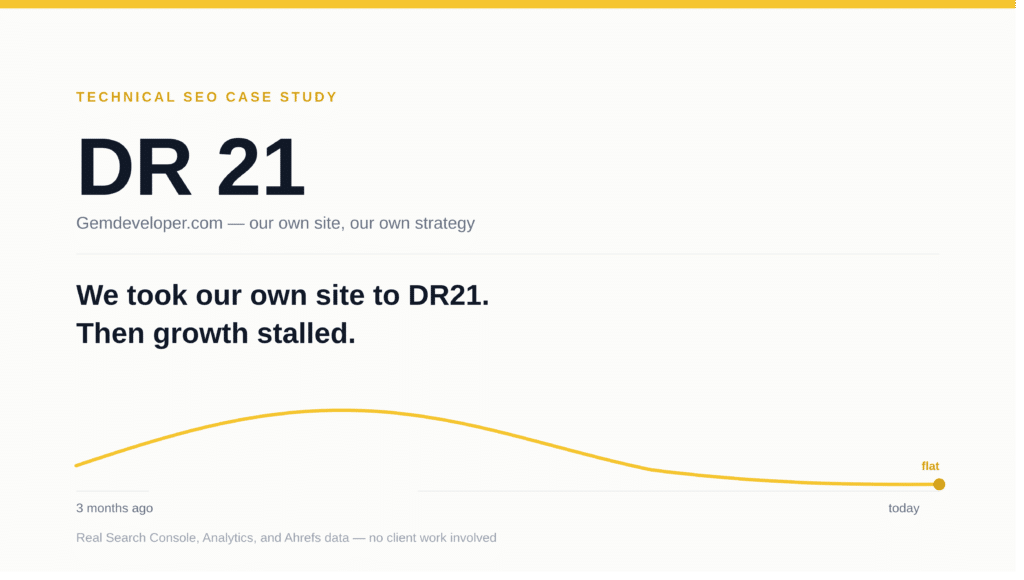
Here’s where it gets specific. Pulling from Search Console and GA4 over the last 3 months:
- Average position: 42–46, confirmed independently by both GSC and GA4 — meaning our content is typically sitting around page 4-5 of Google, not page 1
- CTR: under 1% in most weeks — unsurprising at that position, but worth stating plainly rather than around
- The traffic trend line is flat across the full 3-month window, not declining, not growing — just flat
Where the (few) clicks actually land
We pulled a landing-page breakdown to see which pages, if any, were getting found. Two things stood out:
- Our homepage gets the most engagement, which is expected
- One of our old, pre-repositioning posts — a generic “freelance digital marketing” article, unrelated to our current technical SEO focus — was getting clicks that our newer, more relevant Technical SEO Systems content wasn’t
Meanwhile, queries directly matching our actual niche — wordpress technical audit (51 impressions), seo workflow automation (47 impressions), wordpress technical seo audit (27 impressions), fix technical seo issues wordpress (23 impressions) — all showed real impression volume and zero clicks. The content is topically correct. It’s being shown for the right searches. It’s just not ranking high enough within those results to get chosen.
The variable we didn’t touch
This is the part that actually explains the plateau, and it’s not complicated: Domain Rating and backlink profile stayed exactly where they were before the rebuild, because we didn’t build any new links during this period.
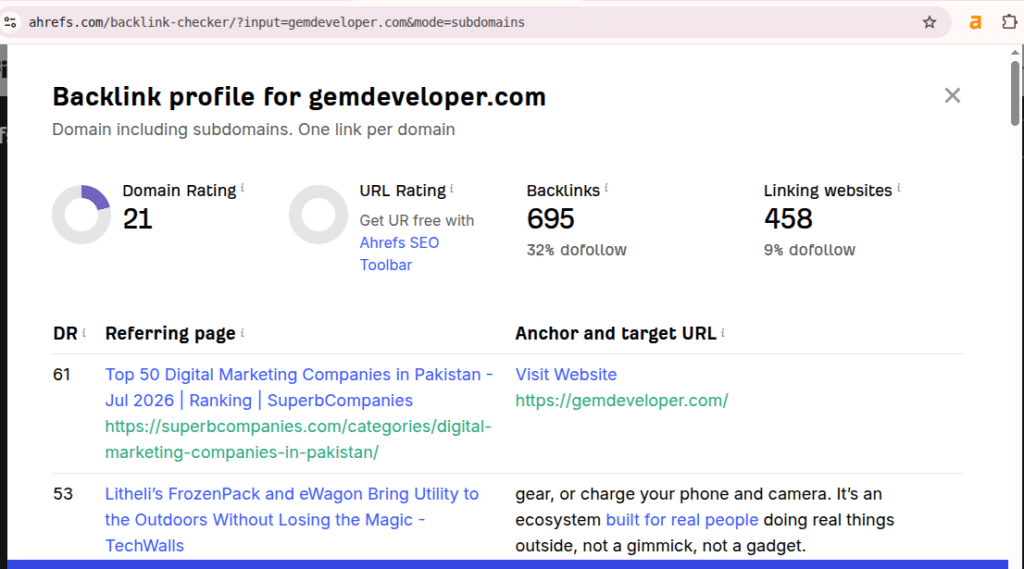
Looking at our existing 458 linking domains, the pattern is telling. One of our stronger referring pages (DR61) comes from a Pakistan-based business directory listing — legitimate, but generic. Another (DR53) is an outdoor gear review site linking to us with anchor text about “an ecosystem built for real people” — a high-authority domain, but with zero topical relevance to technical SEO or automation.
A backlink profile weighted toward generic directories and off-topic placements passes real authority, but likely not the kind of authority Google’s algorithms increasingly reward — topical relevance matters as much as raw Domain Rating. That’s a plausible, specific explanation for why a technically excellent site with a genuine DR21 is still sitting around position 42, when sites with similar or lower DR but more topically relevant links can outrank it.
Where this leaves us — and what we’re testing next
We treat this as an open problem, not a solved one. The technical foundation is now genuinely strong — which matters, because it means the next round of work isn’t undoing bad decisions, it’s adding the piece that was missing. That’s exactly the kind of prospecting and outreach system we’ve built with n8n — the same one we use to find and reach relevant sites in our own niche, which we’re breaking down in detail in our next post.
→ See how we’re systemizing this with n8n-based prospect finding and outreach
FAQ
Your Attractive Heading
Does technical SEO work matter if it doesn’t move rankings on its own? Yes — technical SEO is a prerequisite, not a ranking driver by itself. A technically broken site caps how well back-links and content can perform; a technically clean site doesn’t rank on its own without sufficient relevant authority behind it. Both layers matter, but they’re not substitutes for each other.
How long should you wait before concluding a plateau is real? Three months of flat position and traffic, with no other major site changes in that window, is generally enough to conclude the plateau isn’t a temporary indexing lag — especially when reindexing has already been requested and processed, as it has here.
Is Domain Rating the right metric to focus on? DR is a useful proxy for overall link authority, but it doesn’t account for topical relevance. A lower DR from a highly relevant site in your niche can outperform a higher DR from an unrelated one — which is part of what this data suggests is happening here.