Answer first: An automated prospecting system connects prospect discovery, structured data collection, contact intelligence, data processing, campaign preparation, and outreach execution into one connected workflow. Instead of manually searching for prospects, collecting website information, finding contact details, organizing everything in spreadsheets, and preparing campaigns separately, businesses can design a system that moves information through each stage in a structured way.
The Prospecting Automation Pipeline
A multi-stage prospecting system can be represented as follows:
Search criteria → Prospect discovery → Structured data → Contact intelligence → Data processing → Campaign preparation → Outreach execution
Each stage has a different responsibility. The discovery stage finds potentially relevant websites and pages using a search engine APIs like Serper. The data stage organizes the information. The contact intelligence stage processes available contact information. The campaign stage uses the resulting data for a specific outreach objective.
This separation is important because a prospecting system should not depend on one giant workflow trying to perform every task at once.
Stage 1: Start with a Search Objective
Every prospecting workflow begins with a question.
- Which businesses operate in a particular industry?
- Which companies may need a specific service?
- Which websites are relevant to a particular campaign?
- Which businesses operate in a specific market?
- Which publications or websites may be relevant to an outreach campaign?
The search objective determines the quality of the prospects discovered later.
A vague search produces a broad and often poorly qualified list. A well-defined search objective gives the automation system a better starting point.
In the system we built, a search query is entered at the beginning of the workflow. The search process then identifies relevant results and passes the resulting information into the next stage.
Automation can process a search efficiently, but the quality of the search objective still determines the quality of the prospecting process.
Stage 2: Turn Search Results into Structured Prospect Data
Search results are not yet a useful prospect database. They are simply raw information.
A useful system needs to convert the results into structured records.
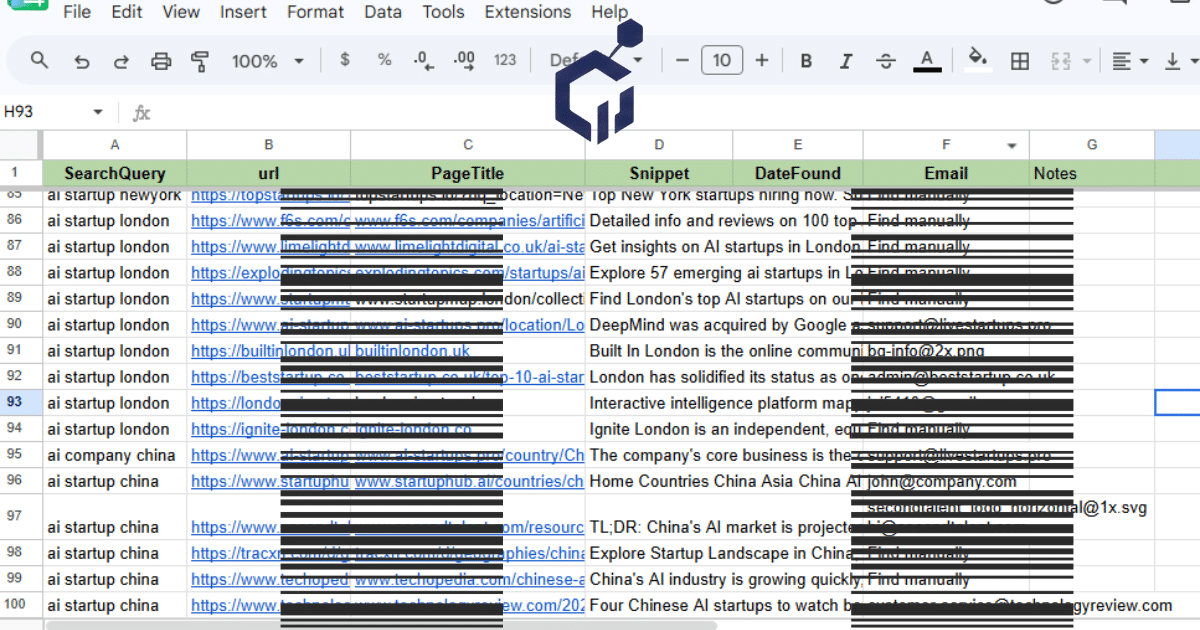
A prospect record may include information such as the following:
- the original search query
- the discovered URL
- the page title
- the page description or snippet
- the date the prospect was found
- contact information
- notes
- additional business information
This creates a central data layer that can be processed by later workflows.
For example, a prospect database might contain:
| Search Context | URL | Page Title | Description | Contact Data | Notes |
|---|---|---|---|---|---|
| Target industry or service | Website page | Page title | Page context | Processed contact | Qualification notes |
The exact fields depend on the campaign. A system designed for editorial outreach may require different information from one designed for client prospecting.
This is why automation should be designed around the business process rather than around a fixed list of tools.
Stage 3: Contact Information Requires Processing
Finding an email address is not the same as finding a useful contact.
A website may contain multiple email addresses, old addresses, technical addresses, unrelated addresses, addresses belonging to third-party services, or malformed and incomplete email data.
A simple extraction process may return everything it finds. That does not necessarily produce a useful prospect database.
The system we built includes a separate contact-processing stage. The purpose is to process the information collected from websites and identify the contact data that is most relevant to the target domain and campaign.
This stage can involve:
- collecting available email information
- cleaning unusable results
- removing irrelevant data
- identifying useful contact points
- associating the information with the correct website or prospect
A system that collects more data is not automatically better. The goal is to produce more useful data.
Why Data Cleaning Matters
Raw automation output is rarely perfect.
A system may encounter the following:
- duplicate addresses
- malformed extraction results
- irrelevant email addresses
- incomplete website information
- websites that cannot be processed
- pages with no publicly available contact information
Without a cleaning stage, these problems are passed into the campaign system.
That can result in wasted outreach, poor data quality, irrelevant messages, increased manual review, and unnecessary delivery problems.
For this reason, the prospecting system separates discovery from contact processing. The discovery workflow finds potential prospects. The contact-processing system then evaluates the available information before it becomes campaign data.
Stage 4: The Prospect Database Becomes the Connection Layer
A structured database connects the different parts of the system.
The prospect discovery workflow writes information into the database. The contact-processing workflow reads the relevant website information and updates the contact data. The campaign workflow then reads the processed information when preparing outreach.
The structure can be represented as:
Discovery → Database → Contact Processing → Database Update → Campaign Workflow
This means each workflow can perform one specific job while still contributing to the same overall system.
This architecture also makes the system easier to adapt. A business may change its search source, contact-processing method, email delivery provider, campaign objective, or prospect qualification criteria without necessarily rebuilding the entire system.
Stage 5: Outreach Depends on the Campaign Objective
The same prospecting infrastructure can support different types of campaigns. The objective determines how the data should be used.
Client Prospecting
A business may want to identify companies that could benefit from a specific service. The system can help organize relevant businesses and prepare the data required for a targeted campaign.
Editorial Outreach
A campaign may focus on relevant websites, publications, or editorial contacts. The qualification criteria will be different from a client acquisition campaign.
Partnership Outreach
A business may want to identify potential partners or complementary companies. The system can help organize and process those opportunities.
Digital PR
A campaign may require identifying relevant publications or contacts connected to a specific topic or market.
The same underlying infrastructure can support the discovery and data-processing stages.
The important point is that automation infrastructure should not be confused with a single fixed campaign. The system is a framework. The campaign objective determines how that framework is used.
Stage 6: Campaign Preparation Can Use Prospect Context
A generic email sent to every prospect is rarely the best use of an automated system.
The available prospect information can provide context for campaign preparation.
Depending on the campaign, this may include:
- the original search context
- the website
- the page title
- the page description
- the type of business
- the service being offered
- the campaign objective
This information can help create a more relevant outreach process.
The goal is not to pretend that automation can replace strategy. The goal is to make the available information more useful before the campaign is launched.
Automation handles repeatable processes. Strategy determines whether the process is worth executing.
Why the System Is Divided into Separate Workflows
One of the most important design decisions is separating the system into multiple stages.
A simplified architecture looks like this:
- Workflow 1: Prospect Discovery — Find relevant websites and store structured prospect data.
- Workflow 2: Contact Intelligence — Process website information and update the prospect record with useful contact data.
- Workflow 3: Campaign Execution — Use qualified prospect data for campaign preparation and outreach.
This approach provides several advantages.
Easier Troubleshooting
If prospect discovery stops working, it can be diagnosed separately from the email-processing system.
Easier Maintenance
A change to one part of the process does not necessarily require rebuilding everything.
Greater Flexibility
Different search sources, processing systems, and campaign tools can be connected as requirements change.
Better Data Control
Each stage can validate and improve the information before passing it forward.
Easier Expansion
Additional stages can be added later, such as lead qualification, CRM synchronization, campaign tracking, response classification, reporting, and notifications.
This is the difference between a collection of automations and an automation system.
Automation Does Not Replace Prospecting Strategy
Automation is not a substitute for understanding the target market.
A technically advanced workflow can still produce poor results if the search criteria are too broad, the wrong prospects are targeted, the offer is not relevant, the outreach message is generic, or the campaign objective is unclear.
The automation system improves the process. It does not eliminate the need for good decisions.
Strategy decides what should happen. Automation makes repeatable parts of the process easier to execute.
Common Problems in Automated Prospecting Systems
Duplicate Prospects
The same business may appear in multiple searches. A system needs a way to identify and manage duplicate records.
Poor Search Criteria
A broad query can produce large amounts of irrelevant data. Better automation cannot compensate for poor targeting.
Incomplete Contact Data
Some websites do not publish contact information. Others may contain information that requires manual review.
Unusable Extracted Data
Raw extraction can produce malformed or irrelevant results. Data cleaning is therefore an important part of the system.
Website Availability Problems
Some websites may be slow, unavailable, protected, or structured in a way that makes automated processing difficult.
Changing Data Sources
Search providers, APIs, email systems, and other services can change over time. A flexible system should avoid becoming unnecessarily dependent on one specific external component.
Campaign Quality
Automation can help prepare and execute a campaign, but irrelevant or poorly targeted outreach remains a strategic problem.
When Does a Business Need Custom Prospecting Automation?
A custom prospecting system may be useful when a business repeatedly performs the same process:
- Search for a specific type of prospect.
- Review websites.
- Collect information.
- Find contact details.
- Organize the data.
- Prepare outreach.
- Launch campaigns.
If these steps are repeated regularly, manually moving information between systems can become a significant operational burden.
Custom automation may be worth considering when a business:
- repeatedly researches similar prospects
- manually transfers data between different tools
- runs recurring outreach campaigns
- needs a structured prospect database
- requires custom qualification rules
- needs different workflows for different markets
- wants to connect research, data processing, and outreach
The correct system depends on the actual business process. There is no universal automation workflow that works equally well for every company.
The Real Value of Automation Is the Connection Between Processes
The greatest value of a system like this is not one individual workflow. It is the connection between the stages.
A search result becomes structured data. Structured data becomes a prospect record. The prospect record can be processed for contact information. The processed information can then support a campaign.
This creates a connected operational system:
Discovery → Data → Intelligence → Action
Without these connections, businesses often perform the same work repeatedly in separate tools. With a properly designed system, repetitive processes can become more structured and easier to manage.
Build the System Around Your Process
The tools should come after the process.
Before building an automation system, a business should understand:
- what information enters the system
- what decisions need to be made
- which steps are repetitive
- where data is currently lost
- which tasks require human judgment
- what output the business actually needs
Only then should the technical architecture be designed.
A system built around a real business process is usually more useful than a collection of disconnected automations assembled simply because individual tools are available.
Final Takeaway
Automated prospecting is not simply about finding more websites or sending more emails.
A useful system connects multiple operational stages:
Search → Discovery → Structured Data → Contact Intelligence → Qualification → Campaign Preparation → Outreach
Each stage has a different purpose.
The system can be adapted for different objectives, including client prospecting, editorial outreach, partnerships, digital PR, and other growth campaigns.
The most important principle is to design the automation around the business process.
If your team is repeatedly moving prospect information between search results, spreadsheets, contact research, and outreach tools, the problem may not be a lack of effort.
It may be a workflow architecture problem.
GemDeveloper designs custom automation and growth infrastructure around the way businesses actually collect data, process information, and execute growth operations.
Explore Growth Systems and Services
About the Author
Kashif Mehmood is the founder of GemDeveloper Digital Solutions, a technical SEO and growth infrastructure consultancy. He builds systems that combine technical SEO, automation, data collection, and outreach workflows to help businesses identify relevant opportunities and improve their growth processes.
His practical work includes building custom prospecting and outreach systems that connect search data, website analysis, email discovery, data processing, and campaign workflows.